


Choosing ADA compliant access solutions is an important part of commercial planning and construction. Architects and contractors must weigh design, site conditions, code requirements and installation needs to make an informed decision. In this learning resource from National Ramp, we explain the key considerations guiding those choices, exploring how access planning can support compliance, usability and smoother project delivery.
On commercial building projects, best results tend to come from early planning, while site layout, grade changes, circulation and entrances are still being developed. Integrating access solutions into the earliest planning states gives their teams room to create an accessible route that’s practical to build, clear to navigate and aligned with their project’s compliance path.
When urgent needs arise, National Ramp can support tight timelines with rapid quoting, CAD drawings within hours, permit-ready quote packets and commercial access systems that can be delivered and installed on demanding schedules.
The ADA Standards for Accessible Design remain the federal baseline for newly designed and altered public accommodations, commercial facilities and state and local government facilities covered by the ADA. Keep reading to learn more about how architects and contractors choose ADA compliant access solutions.
ADA Accessibility Planning in Construction
A strong access strategy begins with the route itself. Under ADA Standards, at least one accessible route must connect site arrival points such as accessible parking, passenger loading zones, public streets, sidewalks and public transportation stops to the accessible entrance they serve. It’s also important to note that accessible routes must also connect accessible buildings, facilities, elements and spaces on the same site.
This matters when teams are thinking about how architects design ADA compliant buildings. Access planning influences where ramps or platforms should begin, how they should be arranged and how users will move through the site safely and confidently.
Key Compliance Considerations
The U.S. Access Board provides helpful information on many compliance requirements, and is useful to architects and contractors who need a clear grasp of the core accessibility design requirements affecting ramps, stairs and platforms. An an overview, here are some of the key compliance considerations involved:
- A walking surface with a running slope up to 1:20 can be part of an accessible route.
- Once the running slope becomes steeper than 1:20, it’s treated as a ramp.
- Ramp runs can be no steeper than 1:12.
- Accessible routes generally need a continuous clear width of at least 36 inches.
- Handrails are required on ramps with a rise greater than 6 inches.
- A ramp run can rise no more than 30 inches before a landing is required.
Other points that demand close review during planning and procurement include:
- Landings, handrail placement, and route width all affect how usable and buildable the final layout will be.
- Site drainage, grade, and threshold conditions can affect field performance. This is an inference drawn from the ADA’s route, entrance, and ramp requirements.
Choosing the Right Ramp or Stair Solution
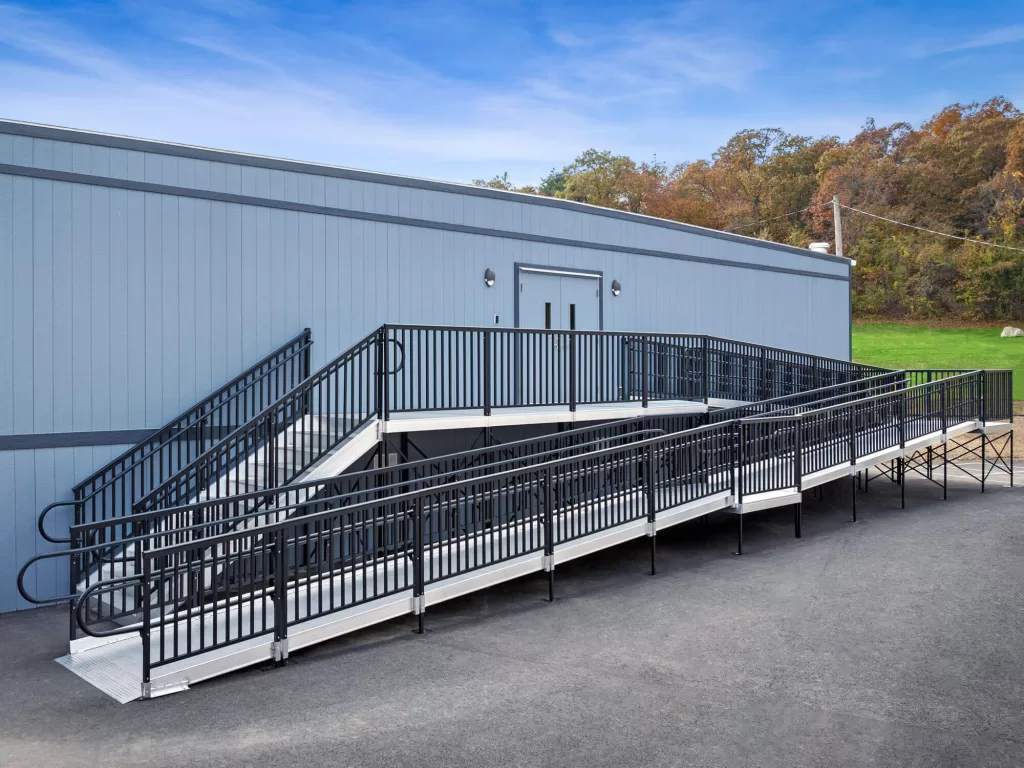
When teams are focused on choosing ADA compliant ramps for construction, they need to match the system to the job the route is doing. On commercial projects, that decision is often shaped by grade change, available footprint, building use, circulation patterns and the installation timeline.
This is where commercial accessibility ramps should be evaluated as part of a wider route strategy rather than as a late add-on. ADA requirements are useful here because they tie route decisions to slope, width, landings and handrails rather than to a product label alone. A useful review usually includes:
- Whether the accessible route needs to overcome a change in level at an entrance, parking connection, or site transition
- How much run length and landing space is available within the footprint
- Whether stairs are also needed for general circulation or code-related movement through the site
- Where platforms can improve layout and user flow
- How quickly the access system needs to be delivered and installed
That’s one reason modular commercial systems appeal to architects and contractors. They can support speed, consistency, and adaptability on projects with uneven grades, phased work, or active site conditions. National Ramp’s unique process is of benefit in these settings as it wraps around real project constraints while supporting route requirements.
Working with Accessibility Regulations
Architects and contractors also need to understand the broader regulatory picture. The ADA Standards establish the federal accessibility baseline. Meanwhile, the authority having jurisdiction will enforce the building code adopted for the project, along with any state or local amendments. That means ADA building accessibility should be reviewed alongside the applicable code framework. For more guidance on local requirements, our Compliance Code Guide is a must-read.
During the construction phase, OSHA requirements can affect temporary access for workers. OSHA requires a stairway or ladder at personnel points of access where there is a break in elevation of 19 inches or more and no ramp, runway, sloped embankment, or personnel hoist is provided.
Designing Buildings for Inclusive Access
Inclusive access improves how a building functions for the people using. A well-planned route is easier to find, easier to understand and easier to integrate into the life of the site.
That benefits visitors, employees, tenants, and owners. Architects who think carefully about arrival points, route continuity and entry conditions create buildings that serve people more effectively. At the same time, contractors installing systems with those goals in mind help bring that intention to life.
Frequently Asked Questions
Who is responsible for ADA compliance in construction?
Responsibility is shared across the project team. Owners, architects, contractors, consultants and product partners may all influence compliance depending on the scope and contract structure. The ADA sets federal accessibility requirements for covered facilities, while local officials enforce adopted building codes.
Architects design ADA access by starting with the accessible route and then coordinating entrances, slopes, landings, widths, handrails and vertical circulation around it. ADA Standards require accessible routes from site arrival points to accessible entrances and accessible spaces on the site.
The answer depends on the building, site and route conditions. Commercial buildings generally need an accessible route connecting arrival points, entrances, and required spaces. For expert guidance on ADA access solutions for commercial buildings, reach out to our Commercial Access experts.
National Ramp: Freedom Now
Choosing the right access solution early can make a meaningful difference to planning, installation, and long-term usability. Contact National Ramp to discuss your project and find commercial access systems that support confident decision-making from design through delivery.
Don’t Risk Injury To You Or A Loved One
Why wait? Give us a call at 877-596-7293 or contact us online to get started!