

Does My Commercial Ramp Need Railings?  

Categories: News ,

Is your commercial building project almost wrapped up except for a few finishing touches, such as handrails for ramps? In some situations, the original drawings for the project lack guidelines for wheelchair ramps and handrails. With a limited amount of time, you may wonder if ramps need handrails to comply with guidelines set by The Americans with Disability Act (ADA). Commercial Access is here to provide more information on when ramps need handrails.

Do Wheelchair Ramps Need Handrails? ADA Guidelines Explained

Whether a ramp needs rails or not depends on the type of property and dimensions of the ramp. The Americans with Disability Act states that commercial buildings and other public locations, such as schools, parks and government buildings, require wheelchair ramps with handrails. Residential buildings do not have to comply with ADA requirements.

According to the ADA, ramps require handrails if they have a rise of 6 inches or more and a horizontal projection of at least 72 inches. The act also states that wheelchair ramps need handrails on both sides. However, curb ramps do not need handrails.

In addition to ramps needing handrails on both sides, the handrails must meet specific criteria. The ADA guidelines state that the interior handrail on dogleg or switchback ramps must be continuous. If the inner rail is not continuous, it must be 12 inches longer than the top and bottom ramp segments. The handrails must also be parallel to the floor surface.
Why Do You Need Handrails on a Ramp?

Why Do You Need Handrails on a Ramp?

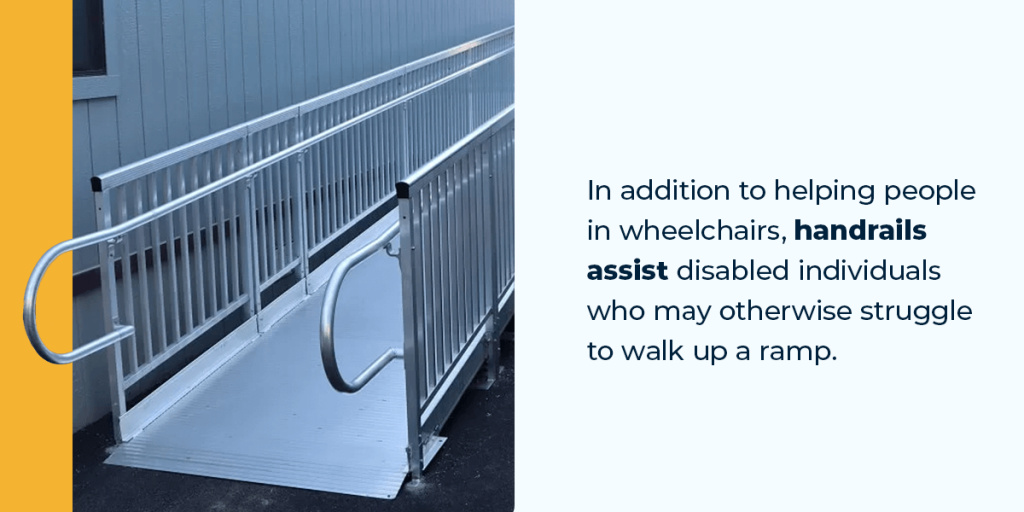
Besides being an ADA requirement, handrails offer disabled individuals convenience, making it easier to use wheelchair ramps. In addition to helping people in wheelchairs, handrails assist disabled individuals who may otherwise struggle to walk up a ramp. Handrails also provide extra safety for anyone using them, especially during wet or icy conditions when ramps become slippery. Handrails provide people with much-needed security and stability when walking up a ramp.

Ready to spec a compliant ramp with handrails for your project?
Request a same-day quote from Commercial Access.

Frequently Asked Questions

What height should handrails be on a commercial ramp?

ADA Standards require handrail gripping surfaces to be between 34 and 38 inches above the ramp surface, measured vertically. The height must be consistent along the full length of the ramp run.

How far must handrails extend beyond the top and bottom of a ramp?

Under ADA Standards, handrails must extend horizontally at least 12 inches beyond the top of the ramp and must follow the slope of the ramp run for at least 12 inches beyond the bottom. This extension gives users a stable grip when transitioning on and off the ramp.

What clearance is required between a handrail and the wall?

ADA Standards require a minimum of 1.5 inches of clearance between the handrail gripping surface and any adjacent wall or surface. This ensures users can get a full grip along the entire length of the rail.

Do OSHA ramps require handrails?

OSHA standards apply to workplace ramps rather than public-access ramps. Under OSHA 29 CFR 1910, handrails are required on the open sides of ramps where there is a fall hazard. For ramps used in commercial workplaces — loading docks, mezzanine access, and similar — both ADA and OSHA requirements may apply depending on who uses the ramp and whether the space is employee-only or open to the public.

Do modular or prefabricated ramps need handrails?

Yes. Modular and prefabricated ramps used in commercial settings follow the same ADA requirements as permanent installations. If the ramp has a rise greater than 6 inches, handrails are required on both sides regardless of whether the structure is modular or custom-built.

What grip diameter is required for ADA-compliant ramp handrails?

ADA Standards require handrail gripping surfaces to have an outside diameter between 1.25 and 2 inches, or a perimeter between 4 and 6.25 inches for non-circular cross-sections. This ensures users can grip the rail securely along its full length.

Are handrails required on temporary or portable commercial ramps?

Yes. Modular and temporary ramps used in commercial settings are subject to the same ADA requirements as permanent ramps. If the ramp has a rise greater than 6 inches, handrails must be installed on both sides.

What happens if a commercial ramp does not have handrails?

A ramp without required handrails is non-compliant with ADA Standards and exposes the property owner to liability under the ADA. It may also fail inspection, delay permitting, and create a fall hazard. Commercial Access can retrofit handrails to existing ramp installations — contact us for a quote.

Contact Commercial Access Today!

Many architectural drawings do not include ramps and handrail specifications, leaving contractors and project managers in a tight spot, especially when the project nears completion. That’s where Commercial Access comes in.

We provide fast, quality results in emergency situations. You can count on us to complete the CAD drawings in a few hours and issue a quote on the same day. Our products are always in stock, allowing us to install modular access systems quickly and efficiently. Contact us today for a quote on handrails for wheelchair ramps. 

Don’t Risk Injury To You Or A Loved One

Why wait? Give us a call at 877-596-7293 or contact us online to get started!

Contact Us Call Us Now for your
free evaluation 877-596-7293